

How Can Companies Assess the Leadership Capabilities of their Mid-Level Managers?
By Dr. David Livingston
Mid-level managers are the lynchpins of every organization. They turn strategy into execution. They translate vision into action. They are the change agents who make transformation real and the culture carriers who set the tone day to day. When organizations struggle to execute, the root cause is often not strategy – it’s leadership capability in the middle of the enterprise.
Yet assessing mid-level managers remains one of the most misunderstood and poorly executed practices in leadership development. Many organizations rely on generic competency models, personality instruments, or one-size-fits-all surveys that fail to reflect the real demands of the role. The result is data that looks impressive but produces little meaningful change.
The world of a mid-level manager is the very definition of VUCA – volatile, uncertain, complex, and ambiguous. This world demands adaptability. These leaders operate at the intersection of competing priorities: senior leadership expectations, frontline realities, cross-functional dependencies, and rapidly shifting business conditions. Success requires adaptability above all else. Any assessment intended to evaluate mid-level leaders must be engineered around this reality.
Effective assessment must measure what leaders actually do, not just what they know or prefer. It must capture observable behaviors across the full range of capabilities required to lead in dynamic systems. In practice, the most effective mid-level leadership assessments share three defining characteristics. They are:
Rooted in a research-backed framework
Structured to collect meaningful data
Constructed to produce actionable insights
Rooted in a Research-Backed Framework
There is no shortage of leadership competencies that organizations could choose to assess. The challenge is not scarcity, it is relevance. Only a small number of leadership capabilities truly differentiate effective mid-level managers from those who struggle. A well-designed framework focuses attention on those capabilities that matter most for performance, adaptability, and enterprise impact.
The Lobo Leaders Capability Assessment is built around Four Core Capabilities that consistently predict success in mid-level leadership roles: Strategy Construction, Compelling Communication, Adaptive Execution, and Talent Cultivation. What distinguishes this framework is not just the capabilities themselves, but the recognition that each contains an inherent tension. Effective leaders must flex between seemingly opposing behaviors depending on their people and their environment, and a good assessment helps the leader see themselves in terms of the Four Core Capabilities:
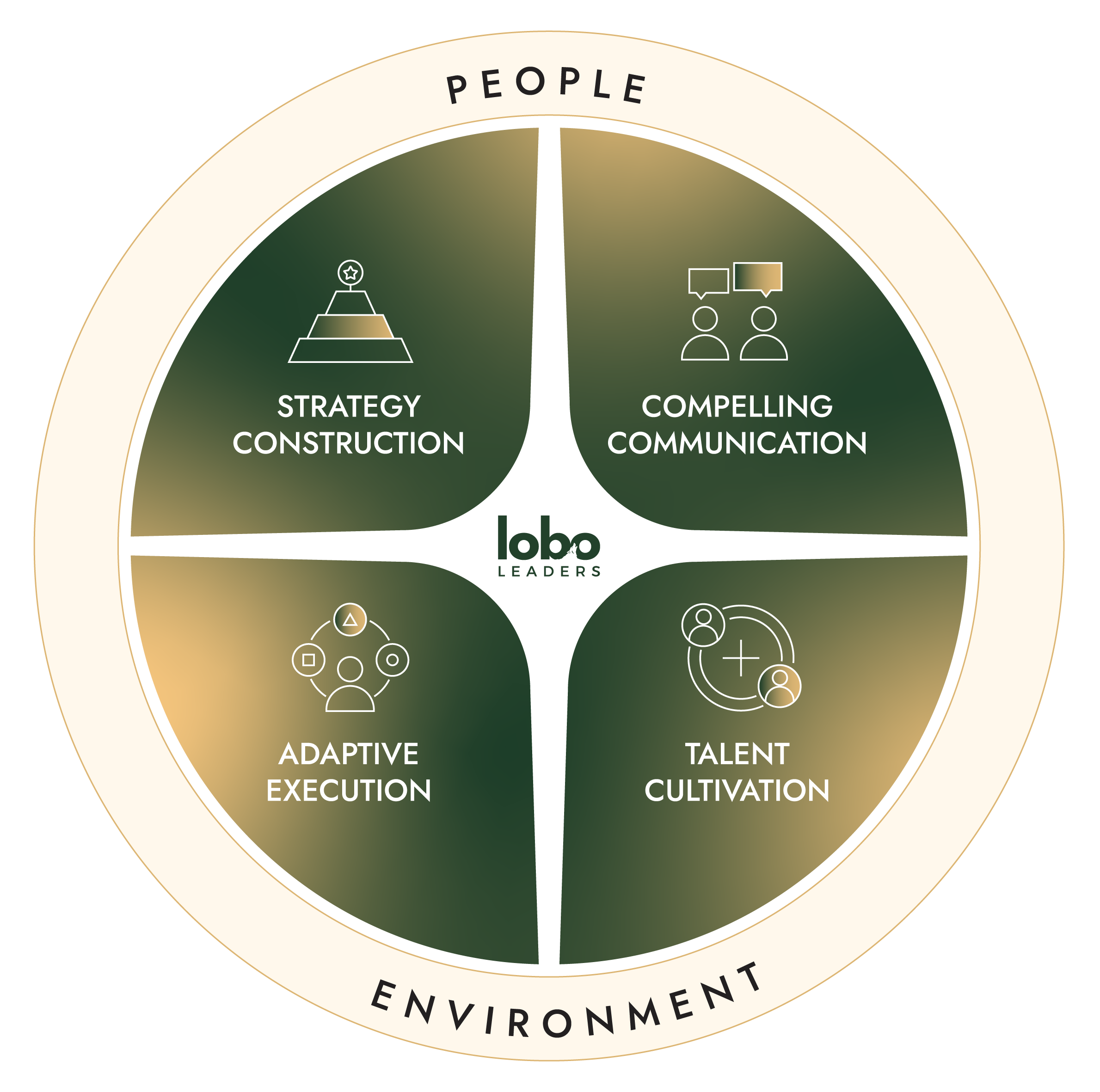
Strategy Construction | Structure + Flex
Strong leaders do not simply set goals; they build the path to achieve them. They create clarity through purpose, priorities, defined outcomes, metrics, and processes. At the same time, they remain alert to environmental signals, actively monitor assumptions, and install feedback loops that allow them to pivot when conditions change. Strategy, at the mid-level, is not static – it is continuously constructed and reconstructed.
Compelling Communication | Deliver + Synthesize
Mid-level leaders sit at the center of information flow. They must deliver messages that align, inspire, and mobilize action. Equally important, they must synthesize information from multiple sources (data, stakeholder perspectives, and frontline feedback) to inform better decisions. Communication is not just transmission; it is sensemaking.
Adaptive Execution | Direct + Empower
Execution is where leadership becomes visible. Effective leaders know when to step in and provide direction by setting priorities, clarifying roles, and allocating resources. They also know when to step back and empower others by establishing clear guardrails, decision rights, and operating cadence. Adaptive execution requires discernment, not control.
Talent Cultivation | Challenge + Strengthen
Sustainable performance depends on developing people. Great leaders raise the bar by setting high expectations and providing direct, actionable feedback. At the same time, they strengthen others through coaching, psychological safety, and opportunities for growth. Talent cultivation is not a soft skill – it is a core driver of organizational capacity.
Structured to Collect Meaningful Data
Even the strongest framework fails without high-quality data. All assessments contain bias; the goal is not elimination but mitigation through thoughtful design.
Multi-rater (360-degree) tools are often assumed to be more objective because they incorporate multiple perspectives. In reality, social dynamics, political considerations, and relationship concerns frequently distort responses. Individual self-assessments avoid these social pressures but are often criticized for overreliance on self-awareness.
This challenge can be meaningfully reduced through behavior-based measurement. Rather than asking leaders to evaluate how effective they believe they are, well-designed assessments ask how frequently they engage in specific behaviors. For example, shifting from “How effective are you at establishing a clear purpose?” to “How often do you establish a clear purpose before an initiative begins?” prompts reflection on real-world behavior rather than aspirational self-image.
Assessment length also matters. Excessively long instruments introduce fatigue, disengagement, and careless responding. Overly short assessments sacrifice reliability and increase the risk of false conclusions. The Lobo Leaders Capability Assessment uses 48 carefully designed, behavior-based questions and takes approximately 15 minutes to complete, balancing depth with usability.
Constructed to Produce Actionable Insights
The ultimate test of any assessment is whether it drives action. Data without direction is noise. If an assessment does not prompt behavior change, skill development, or meaningful conversation, it has failed its purpose.
Many tools focus exclusively on weaknesses or exclusively on strengths. Both approaches are incomplete. Weaknesses that go unaddressed can derail performance, while underleveraged strengths represent missed opportunities. For maximum impact, leaders need clarity on both.
The Lobo Leaders Capability Results Report identifies growth priorities alongside differentiated strengths and pairs each with targeted, practical recommendations. Importantly, the assessment does not attempt to prescribe everything a leader should do. Instead, it prompts leaders to select two to three actions that will deliver the greatest impact, reinforcing ownership and accountability.
The Path Forward
Mid-level managers face relentless pressure and increasing complexity. No assessment is a silver bullet. But the right assessment can provide clarity, focus, and momentum. For organizations investing in leadership development, the question is not whether to assess, but how.
Choose tools that reflect the real demands of mid-level leadership, generate credible data, and translate insight into action. When done well, assessment becomes more than measurement. It becomes a catalyst for growth, alignment, and sustained performance.