What Are the Key Components of a Successful Leadership Development Program for Mid-Level Leaders?
By Dr. David Livingston
There are an astonishing number of Legos in our house: under couches, in desk drawers, occasionally discovered the hard way in the middle of the night. My youngest, Levi, is in constant motion with them, engineering rescue vehicles, hidden lairs, and novel aircraft to match whatever superhero storyline has captured his imagination that day. What begins as a scatter of small, unremarkable pieces becomes, through focus and intention, something surprisingly intricate and new.
That transformation is the magic of thoughtful design: simple components, deliberately combined, can produce results far greater than the sum of their parts.
At its core, designing a successful leadership development program isn’t much different.
A relatively small set of components – clear objectives, relevant content, meaningful practice, coaching, feedback, and peer connection – can be arranged in ways that create a uniquely powerful experience. When thoughtfully constructed, these programs don’t just transfer knowledge, they change behaviors, build capabilities, shift mindsets, and strengthen relationship across the organization.
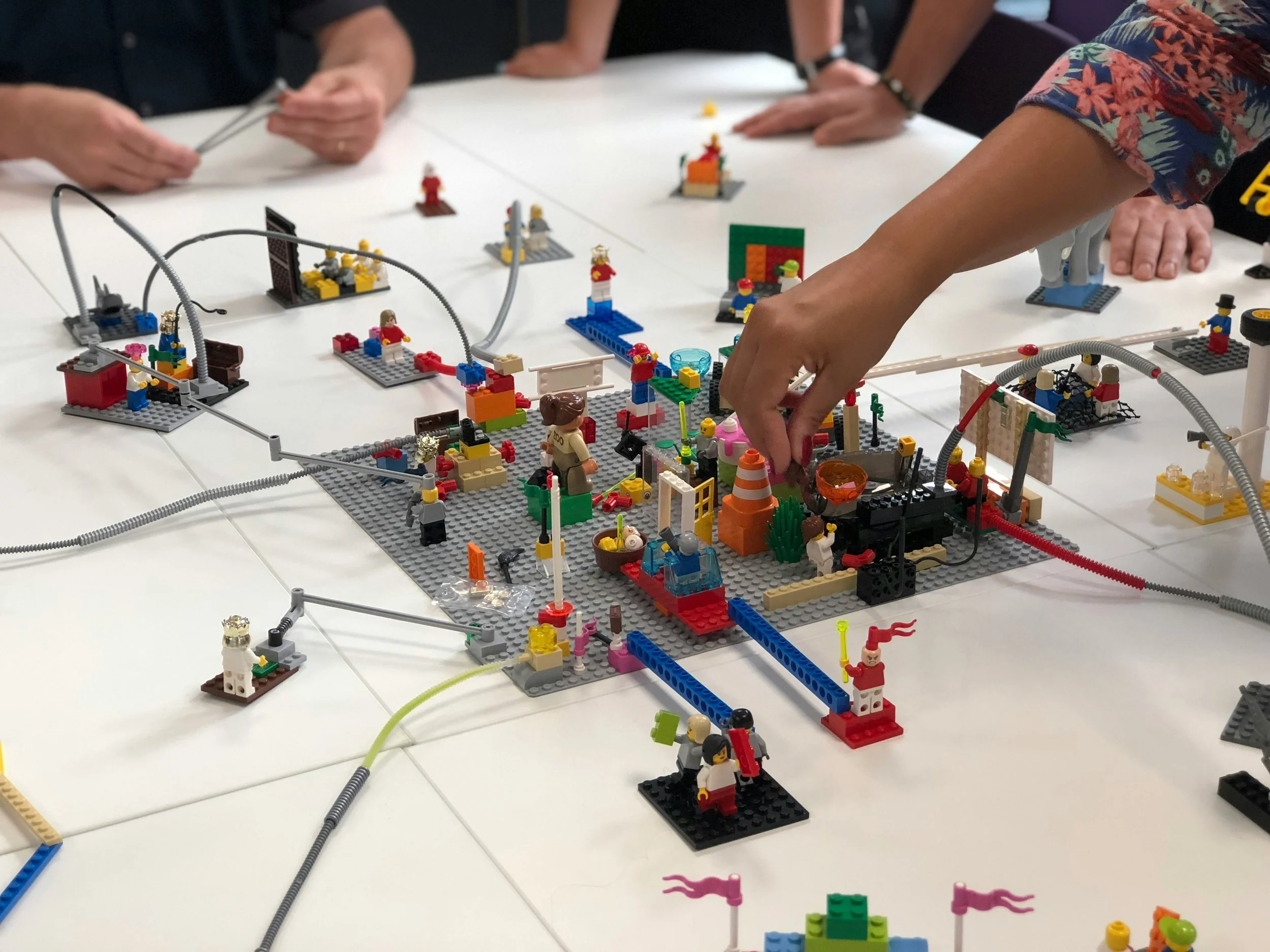
The keys to designing a powerful leadership development program – much like building with Lego blocks – are to:
Start with the big picture in mind
Utilize the right components
Assemble them in the right way
START WITH THE BIG PICTURE IN MIND
Every new box of Legos has a clear picture of the end product shown from multiple angles. Not only do these pictures inspire a child to rip open the package and start building, but it also serves as a reference tool throughout the experience. If pieces don’t fit together properly or things feel off, the child can look back at the picture to reorient their actions.
Good leadership programs start with stated learning objectives of what concepts or skillsets should be gleaned from the experience. But great leadership programs start with identifyingstrategic business outcomes or metrics that must be impacted by the program. These outcomes and metrics then inform learning objectives and a measurement strategy that will track progress and show the return on investment. Only then can an effective program structure be architected based on the end goal and within existing constraints (time, investment, size, availability, methodology, etc.).
A past client in the wealth management industry had an extraordinarily clear objective. They needed to move the needle on acquiring new accounts and they recognized that RegionalDirectors were the key to capturing more accounts. With a firm metric and audience in mind, we were able to develop a highly focused leadership development program that centered every session, activity, and discussion around building the capabilities that would translate to capturing new business. Within two years, the firm saw an increase of over 50% in new accounts.
Pro Tip:Start by asking these three simple questions to begin defining the big picture:
If this program positively impacted the strategy, what metric(s) should we expect to change?
To see the metric(s) move in the right direction, what actions would leaders need to stop and what actions would they need to start?
What specific barriers (habits, structure, technology, culture, systems, etc.) are currently inhibiting these changes?
UTILIZE THE RIGHT COMPONENTS
As a child dumps out the Lego box contents, an instruction manual and clear plastic bags filled with a wide variety of bricks come tumbling out. The manual contains a detailed inventory of each piece, visually depicting the assortment of sizes, shapes, and colors. Often the differences between components are stark, but at other times, the difference is small and that tiny variation makes all the difference in the final product.
A wide array of components are available when designing leadership development programs, and those components continue to evolve as new technologies, particularly AI, are leveraged in new ways to drive lasting change. Strong programs utilize a collection of different components knowing that learning styles vary from leader to leader.
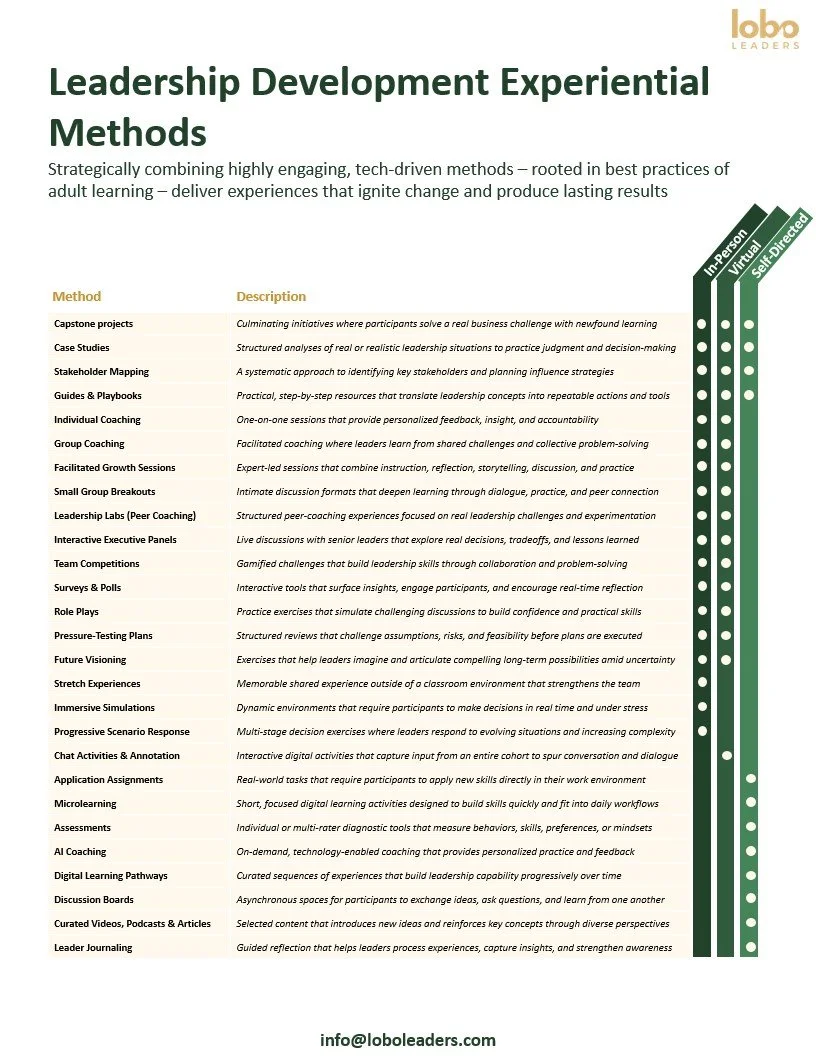
Above is a table of some of the most effective components that Lobo Leaders uses on a regular basis.
A mid-size biotech company partnered with us to design and deliver a powerful leadership program for their population of high-potential leaders. While they wanted to cover a wide range of critical behaviors and skills, they were particularly interested in enhancing their leaders’ ability to leverage AI since they had made major investments in various AI tools but had seen little adoption.
As part of the program design, we partnered with their subject matter experts to weave the concept of AI throughout the entire experience, demystifying the technology and sparking new ideas. First, they experimented with the newest and latest tools during an interactive, facilitated growth session. They also had the opportunity to share their own experiences with AI during small group breakouts and anonymously ask targeted questions to a panel of experts. Finally, they were placed into teams and assigned an AI capstone project in which they identified new, tangible ways that AI could be leveraged across the organization and presented their proposals to a panel of executive judges.
While there was initial trepidation from the participants, these components that centered on AI soon became the highest-rated portions of the experience because of their practicality and usefulness long after the program finished.
Pro Tip: Maintaining attention is critical and increasingly difficult in a world inundated with distractions. During an in-person session, shift your method at least every 10-15 minutes and in a virtual session, shift it at least every 5-7 minutes.
ASSEMBLE THEM IN THE RIGHT WAY
Virtually every Lego block can snap into place – but that doesn’t mean every piece haphazardly belongs in the build when you’re aiming for a specific outcome. When the correct block is selected and placed, not only does it fit nicely at its designated step of the process, but it also serves as the foundation for future components.
When it comes to design leadership development experiences, flow is extremely important – within a session, between sessions, and throughout the program. Humans are hardwired to think in narrative and all good stories have a directional flow. One event connects to the next in a logical way that propels the characters towards a climactic endpoint. Leadership developmentprograms that lack directional flow feel disjointed, confusing and frustrating. Instead of focusing on adopting new behaviors or building new skills, leader attention is focused on trying to find a pattern that makes sense. Not only does an effective leadership development program have a “red thread,” (a thematic idea that connects all aspects of the experience together), but that red thread connects back to the big picture discussed earlier. When that happens, not only do leaders feel like they are personally progressing in their leadership, but they are motivated to be a part of something bigger – organizational success.
We were brought in to design a high-impact, development program by a global sporting goods manufacturer who wanted their marketing leaders to partner more effectively across the organization. We knew this population was highly competitive and would engage more fully if the experience was gamified. We adopted a racing metaphor as our red thread and placed participants into cross-divisional “Pit Crews”. These Pit Crews engaged in a series of activities and events that earned them points over the course of the program. Progress was regularly updated on a digital Leaders Board that encouraged even more friendly rivalry. The program culminated in a pit crew experience where teams had the chance to race each other as theychanged tires on an actual race car. While this stretch experience was fun and energizing, it also formed a shared memorable moment that tied back to key techniques and concepts around collaboration, shaping the way they engaged each other back in the workflow.
Pro Tip: When designing a leadership development program, shift your focus from the component to the transition between components. How does one facilitated growth session connect to the future visioning exercise that directly follows and how does that connect to the team competition that comes later in the day? If you can articulate in one sentence how one component smoothly flows into the next, then you have a solid “red thread.”
CONCLUSION
Levi, my son, never hesitates to take apart a creation that isn’t quite working – and in his world, nothing is ever truly finished. He experiments, swaps pieces, and adapts the design as the story evolves. Developing highly effective leadership development programs requires the same discipline. An iterative approach is needed: continually returning to the big picture, selecting the components that best serve leader needs, and refining how those elements fit together to deliver meaningful, lasting impact.